FileDigr

Free while we test

Is a data center being planned near you?

Type your city, county or ZIP code, or pick it from the list below. FileDigr shows what that place's own public records say, and what it could not check.

Records read October 28, 2026

  • Signal found
  • Partial coverage

Lexington's council approved, on October 22, 2026, an ordinance deleting computer and data processing centers from six zones and a referral of a separate data center zoning category to the Planning Commission. Its moratorium runs to October 31, 2027.

Real records. Lexington-Fayette Urban County.

Or pick a place

When something is found

This is what a briefing looks like. Every conclusion opens the page it came from.

Real records. Lexington-Fayette Urban County, as of October 28, 2026

  • Signal found
  • Partial coverage

Lexington's council approved, on October 22, 2026, an ordinance deleting computer and data processing centers from six zones and a referral of a separate data center zoning category to the Planning Commission. Its moratorium runs to October 31, 2027.

Limit: Only 1 of 5 kinds of record was checked: legislation records on Lexington's public Legistar site, and the documents attached to the eight records cited here. Meeting agendas and minutes, permits, land records and utility filings were not checked, so their silence tells you nothing.

What the record says

Selected passage

Section 4 - That all Divisions within the Urban County Government are directed to refuse to accept, process, review or issue any zone map amendment applications, development plans, or permits/approvals/authorizations as referenced in Sections 1-3, with the exception of applications already filed, if any, for the duration of this moratorium.1
The page it came fromShowHide
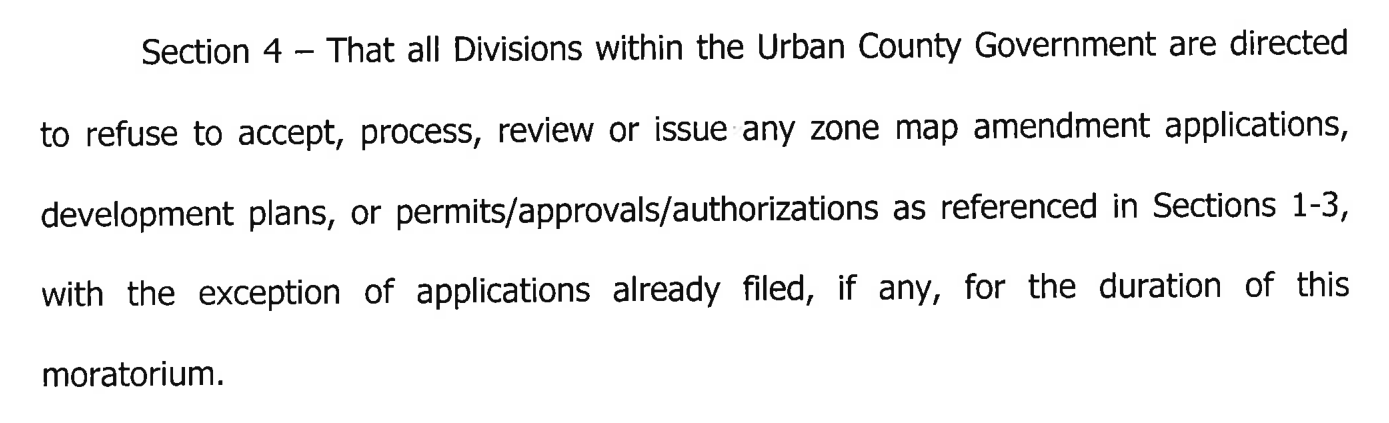
A picture of page 2 of 4 of the stored file (R-235-2026 (signed copy, scanned)), cropped to the passage, with the passage marked in yellow.
The attached file itself, page 2 of 4, as FileDigr stored it on October 6, 2026. The yellow mark is ours. The words under it are the passage quoted above. Open the page full size, without our mark

1 Why this matters: Section 4 states the exception for applications already filed.

In plain words: A moratorium is a temporary pause.

Lexington-Fayette Urban County Council. File created June 9, 2026; final action June 9, 2026.

Original record: Resolution 0528-26 (R-235-2026): Walk on - Moratorium Data Center, Signed copy attached to the record, Section 4 (opens the Lexington-Fayette Urban County Council page in a new tab)
Attached document: R-235-2026 (signed copy, scanned) (opens the file in a new tab)

What it may mean
The council paused three things for a set period: zone changes that come with a data center plan, review of data center development plans, and permits for data centers. Applications already filed, if any, are excepted.
What it does not establish
That any data center is planned or approved here. The resolution names no company and no site, and it does not say whether any application was already filed. It gives an end date and does not say what happens after it.
Next step, what changed, and document detailsShowHide
Next documented step
The same records list the data center regulation text for council member discussion on October 6, 2026.
What changed
First read by FileDigr on October 6, 2026, so there is no earlier check to compare against.
Document
Resolution 0528-26 (R-235-2026): Walk on - Moratorium Data Center, Signed copy attached to the record, Section 4
Office or outlet
Lexington-Fayette Urban County Council
File created
June 9, 2026
On agenda
June 9, 2026
Final action
June 9, 2026
Enactment number
R-235-2026
Retrieved by FileDigr
October 6, 2026
Last successful check
October 6, 2026

The record's status line reads "Approved". The attached signed copy is a scan, read by picture, and says "PASSED URBAN COUNTY COUNCIL: June 9, 2026".

Who it is for

Pick the person closest to you.

Marlene heard a rumor about the county road.

She wants to know tonight whether anything is on the public record. She sees one box, the passage from the record in plain words, the date of the next hearing, and what was not checked.

Free to read. Email alerts are coming.

How it works

  1. We check sources

    Agendas, minutes, and other public records. Each has a named office and a check date.

  2. We tell you plainly

    What the records say, what they do not, and what we did not check.

  3. You see the proof

    Every conclusion opens the passage it came from.

Every square is a public file we read

For the eight places with a briefing, FileDigr has stored and read 2,280 agendas, minutes and attached papers from their meeting sites. 252 of them, the orange squares, use the words "data center" or a similar term. A word is a place to look, not a finding. FileDigr reads meeting records from more places than these; a place gets a column here once its briefing is checked.

  • Uses "data center" or a similar term
  • Does not
  • No readable text yet (54)

Meeting records only. Building permits, land records and utility filings are not read yet in any of these places, so they are not in these squares. Oldest files are at the bottom. Counted October 29, 2026 from the files FileDigr stored.

Which words countShowHide

"data center", "data centers", "data centre", "datacenter", "hyperscale", "server farm". The list is frozen: it cannot change without a new name, so every count is tied to the exact words that produced it. The same list marks a briefing for a closer read.

FileDigr covers named places only. If you pick a place we do not cover, it says so.

See what that looks like

What a checked, an unchecked, and a stale source look likeShowHide

Checked

Checked. Last successful check October 28, 2026.

Not checked

Not checked. Building permits: no tested way to read this system yet.

Stopped updating

Not monitored - last checked 21 days ago.

Know about a place? Send us the link.

If you think a data center may be coming somewhere, send us the public record that shows it. We can only take links, not written tips. Even when a tip is right, we have no way to check it. A record is something we can open, read and show to everyone.

Fill in any box you have a link for. You do not need all four. Each box takes one web address: open the record, then copy the address from the bar at the top of your browser.

A building permit, rezoning request, site plan or variance on a city or county permit website.

A land sale or deed, a parcel record, a tax break or incentive agreement, a utility filing, or a state air or water permit.

An agenda, minutes, meeting video or public notice from a city council, county commission, planning commission or development board.

A published news story. We read the records it points to. A story on its own is only ever shown as reporting, not verified.

We keep the links you send and the time they arrived. Nothing else: no name, no email, no internet address.

What happens to a linkShowHide
  • We open it and read the record on the government's own site, or the records a news story points to.
  • If the record supports a finding, it goes into a briefing with a link back to the original. If it does not, nothing is published.
  • We do not ask for your name or email, so we cannot write back. A briefing never says a tip led to it.
  • A link does not start coverage of a place or promise a date.
Links we cannot useShowHide
  • Written tips, screenshots or forwarded messages with no link to the record itself.
  • Private social media posts, or anything that names a private person.
  • Links that need a login to open.

What an alert can tell you

A weekly check can miss a notice posted at short notice.

Free while we test.

Free while we test. Check any covered area and read the record behind every line. Email alerts are coming.

Check an area

  • Pick a covered place and see what the records say
  • What was not checked, on every result

Read the proof

  • Every conclusion opens the passage it came from
  • A printable copy that keeps its label

Email alerts are coming

  • A message only when a qualifying change appears
  • Your email address and chosen place, nothing else

Chip in

FileDigr is free to use, and nobody has to give anything to use it. If it helps you, you can chip in to keep it running.

Anything you send goes to Rachel Hurley's rachelandthecity account. It is not tax-deductible and does not unlock anything.

What do you count?ShowHide

FileDigr counts three things: how many times each page is opened, how many visits come from other sites, and how each search in the box ends (one of the places we cover, a state news page, a question back to you, or not covered yet). It never keeps what you type, your internet address or anything else that tells one visitor from another. No cookies, nothing saved on your device, no outside counting service. Sign-ups are not open yet.

What happens to my email address?ShowHide

Sign-ups are not open yet. When they open, we will keep only your email address and the place you chose, and use them only to send these messages. We will not sell them or share them.

Will it always be free?ShowHide

Not necessarily. FileDigr costs money to run. If that changes, we will tell everyone who signed up before anything changes, and nobody is asked for money without choosing it.

What exactly is an area?ShowHide

A named place with a defined boundary, such as a township. A ZIP code, a city, and a utility area are different things. We show you which one before you sign up.

How often do you check?ShowHide

Each source has its own schedule, shown on the briefing. In this example the two sources are read once a week, so a hearing called on short notice can be missed.

What happens when a source stops updating?ShowHide

The briefing says so and shows the date of the last good check. Once email alerts start, people signed up for that area will be told.

Find out what the record says.

One box. Plain words. What was found, and what was not checked.